Your Plant cells in hypertonic and hypotonic solutions images are available. Plant cells in hypertonic and hypotonic solutions are a topic that is being searched for and liked by netizens today. You can Get the Plant cells in hypertonic and hypotonic solutions files here. Get all free photos.
If you’re looking for plant cells in hypertonic and hypotonic solutions pictures information connected with to the plant cells in hypertonic and hypotonic solutions interest, you have pay a visit to the right blog. Our site frequently provides you with hints for refferencing the highest quality video and image content, please kindly surf and locate more informative video content and graphics that match your interests.
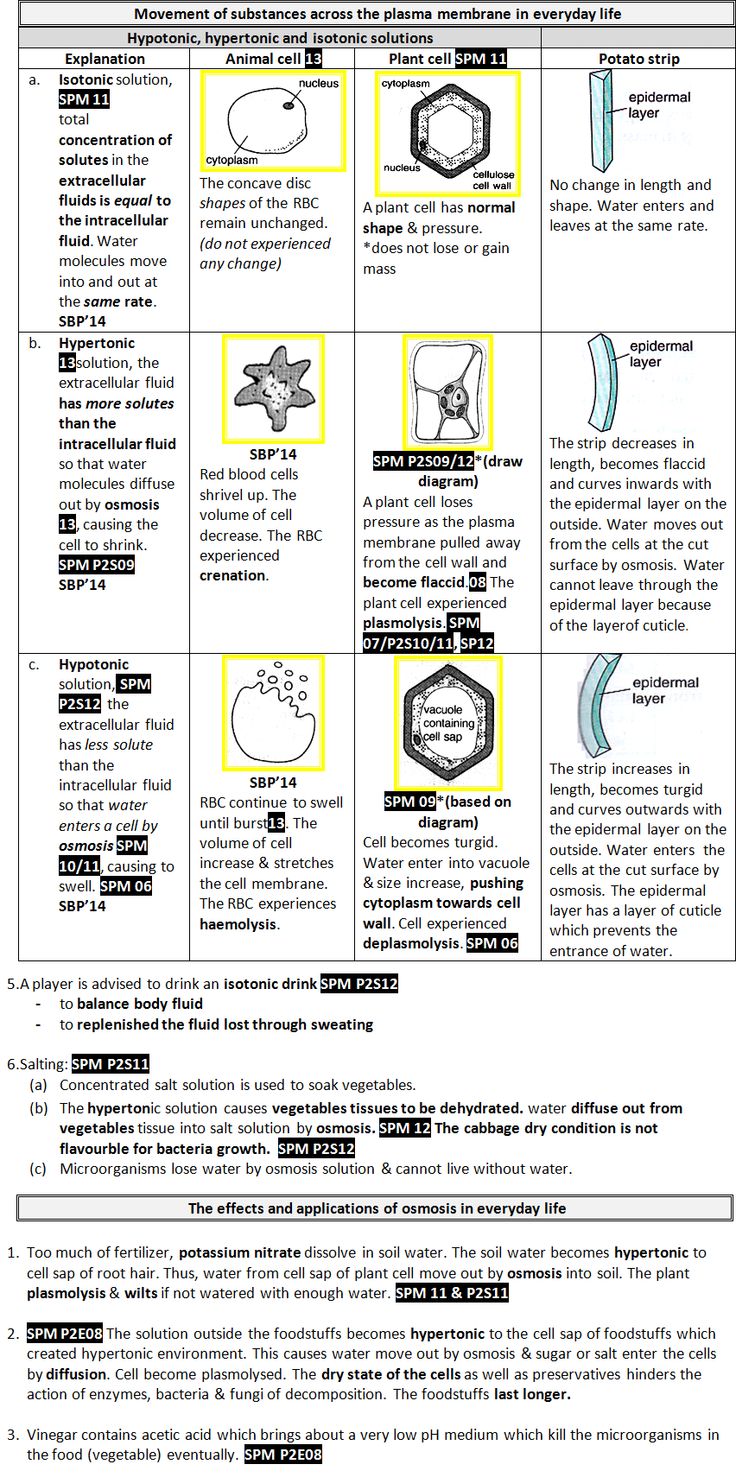
Plant Cells In Hypertonic And Hypotonic Solutions. If a cell encounters a hypotonic environment like pure water for instance water will diffuse into the cell and the cell will begin to swell. When plant cells are placed in such solutions water will move from inside the plant cell to the outside of the cell resulting in the shrinking of the cell the cell is said to be plasmolyzed. Note that the partially permeable membrane here is the plasma membrane and not the cellulose cell wall. One may also ask why are plant cells hypotonic.
 Hypertonic Isotonic Hypotonic Solutions Animal Cell Nursing School Survival Biology Resources From pinterest.com
This occurs because of osmosis. In an isotonic environment there is no net water movement so there is no change in the size of the cell. Animal cells tend to do best in an isotonic environment plant cells tend to do best in a hypotonic environment. Since the concentration of water is higher within the cell there is a net movement of water from inside to outside of the cell. Plant cells have a cell wall surrounding the plasma membrane. Thus the cell remains the same size.
1Plant cell in isotonic solution.
The cytoplasm in the plant cell will have shrunk and pulled away from the cell wall this process is called plasmolysis. Plant cells have a cell wall surrounding the plasma membrane. Deplasmolysis occurs whereas if it is placed in a hypertonic solution the cell undergoes plasmolysis and shrinks. When a cell is placed in a hypotonic. A cell becomes shrivelled in a hypertonic solution while A cell gets swelled in a hypotonic solution. Plant Cell in Hypotonic Solution Plant cells require hypotonic solutions to take up water and maintain their internal pressure called turgor.
 Source: pinterest.com
The opposite solution with a lower concentration is known as the hypotonic solution. Plant cell in hypertonichypertonic soluti. A plant cell behaves differently from an animal cell when placed in a hypotonic solution. In a hypertonic solution a cell with a cell wall will lose water too. One may also ask why are plant cells hypotonic.
 Source: pinterest.com
The solution is isotonic in relation to the cell. A cell whose cytosol is an extremely hypotonic solution compared to its environment will shrivel up and is said to be plasmolyzed. Thus the cell remains the same size. Plant cells have a cell wall surrounding the plasma membrane. If a plant cell is kept in a hypertonic solution then the plant cell loses water and becomes plasmolysed because of osmosis.
 Source: pinterest.com
The cytoplasm in the plant cell will have shrunk and pulled away from the cell wall this process is called plasmolysis. Animal cells tend to do best in an isotonic environment plant cells tend to do best in a hypotonic environment. There will be no change in size water molecules exchanged in and out will be the same. When there are solutes on two sides of a. Plant cell in hypertonichypertonic soluti.
 Source: pinterest.com
If a plant cell is kept in a hypertonic solution then the plant cell loses water and becomes plasmolysed because of osmosis. In the case of a plant cell however a hypotonic extracellular solution is actually ideal. Plant cell in hypertonichypertonic soluti 2. The water driven to equalize the two solutions is drawn from the cell. Water leaves the cell by osmosis hypotonic.
 Source: pinterest.com
Water leaves the cell by osmosis hypotonic. A plant cell behaves differently from an animal cell when placed in a hypotonic solution. A hypertonic solution will make water leave cells but a plant cell looks more like a pincushion than a wrinkled animal cell. Contain higher concentration of solutes and less of water than a cell. The pressure inside the cell rises until this internal pressure is equal to the pressure outside.
 Source: pinterest.com
Since the concentration of water is higher outside the cell there is a net movement of water from outside into the cell. If a cell encounters a hypotonic environment like pure water for instance water will diffuse into the cell and the cell will begin to swell. Hypertonic solutions make plant cells lose water. A cell becomes shrivelled in a hypertonic solution while A cell gets swelled in a hypotonic solution. Plant cells have a cell wall surrounding the plasma membrane.
 Source: pinterest.com
Hypertonic solutions make plant cells lose water. Plant cells have a cell wall surrounding the plasma membrane. When plant cells are placed in such solutions water will move from inside the plant cell to the outside of the cell resulting in the shrinking of the cell the cell is said to be plasmolyzed. In an isotonic environment there is no net water movement so there is no change in the size of the cell. If a plant cell is kept in a hypotonic solution then the plant cell gains water and becomes turgid because of osmosis.
 Source: pinterest.com
When kept in isotonic solutions there is no change in the size. In the case of a plant cell however a hypotonic extracellular solution is actually ideal. A cell with a cytosol that is a hypotonic solution to the environment will lose water to the more hypertonic environment that has more solutes. If a cell is placed in a hypertonic solution water will leave the cell and the cell will shrink. The plasma membrane pulls away from the cell wall as it shrivels a process called plasmolysis.
 Source: pinterest.com
A cell whose cytosol is an extremely hypotonic solution compared to its environment will shrivel up and is said to be plasmolyzed. Since the cell sap has a lower water potential than that of the solution outside the living cell water enters the cell by osmosis endosmosis. Hypertonic solutions make plant cells lose water. Answer If a plant cell is placed in a hypotonic solution the cell swells up ie. One may also ask why are plant cells hypotonic.
 Source: pinterest.com
Cell gains water swells and the internal pressure increases. Plant cell in hypertonichypertonic soluti. A hypertonic solution will make water leave cells but a plant cell looks more like a pincushion than a wrinkled animal cell. A cell whose cytosol is an extremely hypotonic solution compared to its environment will shrivel up and is said to be plasmolyzed. Endosmosis occurs in a hypotonic type.
 Source: pinterest.com
Hypertonic solutions make plant cells lose water. A hypertonic solution will make water leave cells but a plant cell looks more like a pincushion than a wrinkled animal cell. A hypertonic solution is a solution that contains more solute than the cell which is placed in it. Plant Cell in Hypotonic Solution Plant cells require hypotonic solutions to take up water and maintain their internal pressure called turgor. A cell with a cytosol that is a hypotonic solution to the environment will lose water to the more hypertonic environment that has more solutes.
 Source: pinterest.com
The plasma membrane pulls away from the cell wall as it shrivels a process called plasmolysis. Deplasmolysis occurs whereas if it is placed in a hypertonic solution the cell undergoes plasmolysis and shrinks. Alternatively if a cell is placed in a hypertonic solution the cell will shrink due to the movement of water outside the cell through osmosis. If a plant cell is kept in a hypertonic solution then the plant cell loses water and becomes plasmolysed because of osmosis. Endosmosis occurs in a hypotonic type.
 Source: pinterest.com
The opposite solution with a lower concentration is known as the hypotonic solution. Animal and plant cells in a hypotonic solution Solution which contain higher concentration of water and lower concentration of solutes is called as hypotonic solution. Plant cells have a cell wall surrounding the plasma membrane. When there are solutes on two sides of a. A cell with a cytosol that is a hypotonic solution to the environment will lose water to the more hypertonic environment that has more solutes.
Source: pinterest.com
Plant cells have a cell wall surrounding the plasma membrane. Answer If a plant cell is placed in a hypotonic solution the cell swells up ie. A cell with a cytosol that is a hypotonic solution to the environment will lose water to the more hypertonic environment that has more solutes. Contain higher concentration of solutes and less of water than a cell. What happens to a bacterial cell in a hypotonic solution.
 Source: in.pinterest.com
When there are solutes on two sides of a. A cell whose cytosol is an extremely hypotonic solution compared to its environment will shrivel up and is said to be plasmolyzed. When plant cells are placed in such solutions water will move from inside the plant cell to the outside of the cell resulting in the shrinking of the cell the cell is said to be plasmolyzed. A plant cell behaves differently from an animal cell when placed in a hypotonic solution. Thus the cell remains the same size.
 Source: pinterest.com
Animal cells tend to do best in an isotonic environment plant cells tend to do best in a hypotonic environment. Contain higher concentration of solutes and less of water than a cell. The opposite solution with a lower concentration is known as the hypotonic solution. The effect of an isotonic solution is the same but not as obvious because of the rigid wall. 1Plant cell in isotonic solution.
 Source: pinterest.com
The pressure inside the cell rises until this internal pressure is equal to the pressure outside. Water leaves the cell by osmosis hypotonic. In a hypertonic solution a cell with a cell wall will lose water too. What is difference between hypotonic and hypertonic solution. If a cell encounters a hypotonic environment like pure water for instance water will diffuse into the cell and the cell will begin to swell.
 Source: pinterest.com
Animal cells tend to do best in an isotonic environment plant cells tend to do best in a hypotonic environment. The plant cell is said to have become turgid ie. Hypertonic solutions make plant cells lose water. A cell placed in a hypotonic solution will swell due to the movement of water into the cell. A cell whose cytosol is an extremely hypotonic solution compared to its environment will shrivel up and is said to be plasmolyzed.
This site is an open community for users to do sharing their favorite wallpapers on the internet, all images or pictures in this website are for personal wallpaper use only, it is stricly prohibited to use this wallpaper for commercial purposes, if you are the author and find this image is shared without your permission, please kindly raise a DMCA report to Us.
If you find this site helpful, please support us by sharing this posts to your favorite social media accounts like Facebook, Instagram and so on or you can also bookmark this blog page with the title plant cells in hypertonic and hypotonic solutions by using Ctrl + D for devices a laptop with a Windows operating system or Command + D for laptops with an Apple operating system. If you use a smartphone, you can also use the drawer menu of the browser you are using. Whether it’s a Windows, Mac, iOS or Android operating system, you will still be able to bookmark this website.


